Bitcoin user

Blog

  • Four-factor authentication!

    One of the popular bitcoin exchanges is strike.me.  I guess they really want to minimize the risk that somebody could log in under somebody else’s account.  Here is how it went today when I logged in.

    • Step 1.  On my notebook computer, I go to strike.me and I click “log in” and enter my email address.  What happens next is that it sends a secret code number to me by email (if my email address exists in their system).  It invites me to key in the secret code number.
    • Step 2.  Check email again and again and again, eventually receiving the email with the secret code number.  It would be tempting to read the secret code number and key it in on the web page.  But it turns out that the secret code number is itself a URL to a web page.  Nowhere is it documented why you might want to click on this URL, but try it anyway.
    • Step 3.  The URL launches a new web page that invites me to go find my TOTP (time-based one-time password) and key it in.  I do so.
    • Step 4.  What appears next is a page that says I am still not authenticated.  I am invited to go find my mobile phone and launch the Strike app and click to authenticate myself.
    • Step 5.  An email message arrives, letting me know that someone is trying to log in using my email address.
    • Step 6.  I launch the Strike app and click to authenticate myself.
    • Step 7.  I now see that I am logged in on my notebook computer.
    • Step 8.  An email message arrives, letting me know that someone logged in using my email address.

    I suppose depending on how you count it, this amounts to four-factor authentication.  To log in, I had to satisfy something like five conditions:

    • I had to know the email address for logging in.  (In this case it is a custom email address specific to strike.me, so most people would not know the email address.)
    • I had to be able to receive email at that email address.  (Most people would not not be able to receive email at that email address.)
    • I had to be able to generate my time-based one-time password.  (Most people would not be in possession of my TOTP shared secret for strike.me.)
    • I had to be able to lay my hands on my mobile phone, unlock it, launch the strike.me app, unlock it, and then click on the “authenticate” button.
    • If this had all been a bad person somehow trying to hack my account, I would have received not one, not two, but three emails that might have tipped me off.

    On the one hand, this seems a bit extreme and a bit annoying.   On the other hand, I get it that they would want to minimize the risk of somebody hacking my account.
  • Cold wallets and the STEAL miniseries

    cold wallet
    click to enlarge

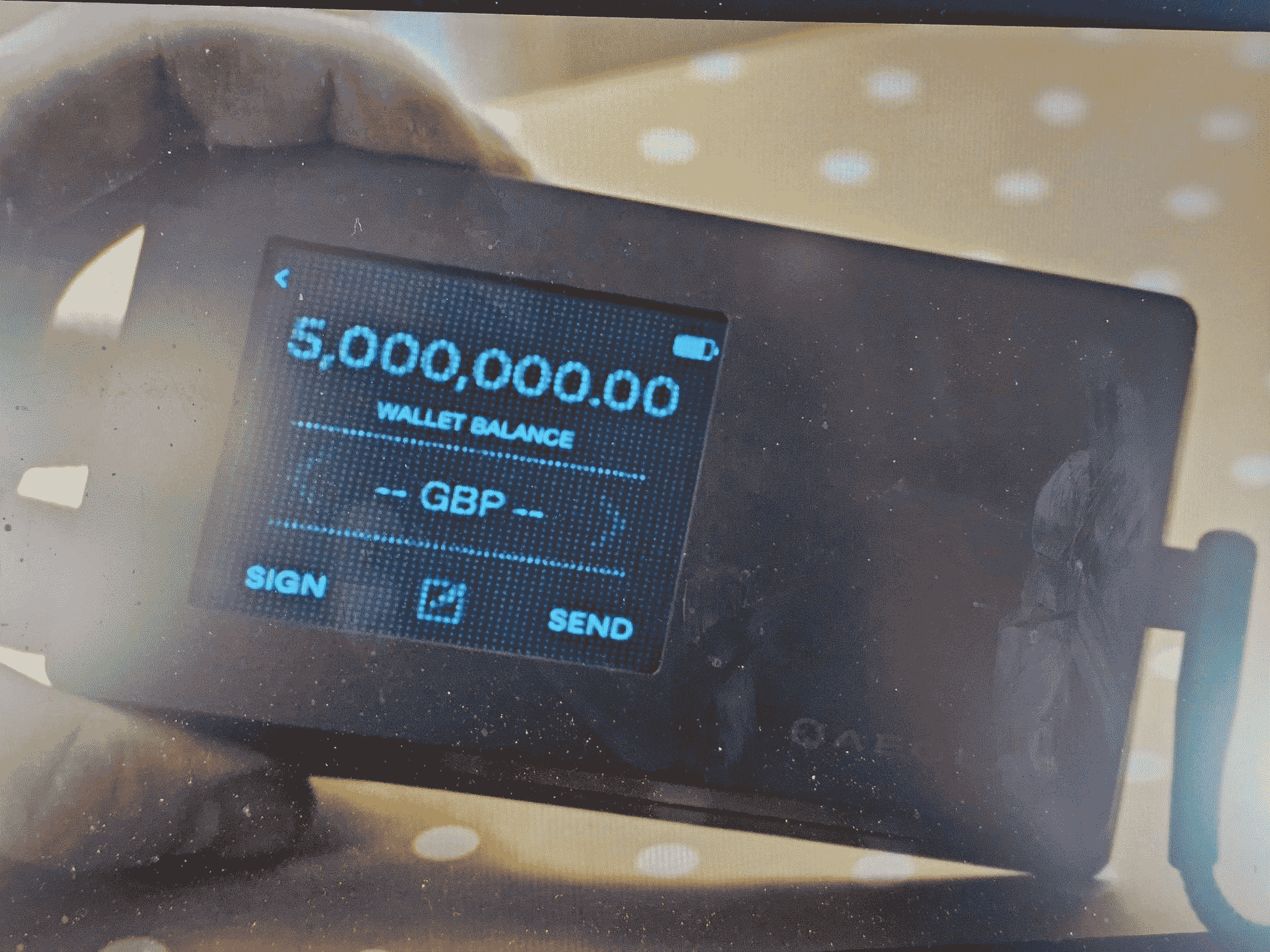
    Sophie Turner (Wikipedia article) was first known to the world as Sansa Stark in Game of Thrones, and now stars in the television miniseries STEAL (Wikipedia article).  Central to the plot are “cold wallets”, meaning the hardware wallets that a person might use for self-custody of cryptocurrency such as bitcoin.  This blog article is rife with spoilers for the miniseries.  Don’t continue if you wish to avoid the spoilers.  (more…)

  • Should I buy and hold bitcoin?

    Whether you should buy and hold bitcoin is a personal decision that depends on your risk tolerance, financial situation, and investment goals. As of late 2025 and early 2026, Bitcoin has demonstrated significant long-term growth, with a 5-year gain of over 200%, but it is also highly volatile and carries risks of significant short-term losses.

    Fun fact:  the verb “hodl” (Wiktionary entry) is used in the bitcoin community to refer to buying and holding bitcoin.

    (more…)

  • Tips for stamping seed plates

    seed card, stamped
    click to enlarge

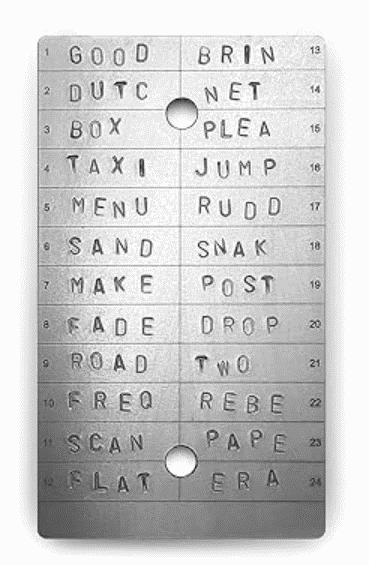
    In this article I will offer some tips for stamping of seed plates.  (more…)

  • Picking a metal for seed plates

    seed card, stamped
    click to enlarge

    What factors might one wish to take into account when selecting a metal for use in seed plates?  What material have many bitcoin owners settled upon?  The answer turns out to be titanium, as will now be discussed.   (more…)

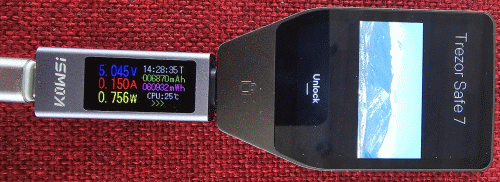
  • Power consumption of Trezor Safe 7

    power meter connected to hardware wallet
    click to enlarge

    How much power does a hardware wallet consume when it is running? (more…)

  • How does bitcoin price compare across several web sites?

    The price of bitcoin typically varies slightly across different websites and exchanges at any given time, primarily due to the decentralized nature of cryptocurrency markets where each exchange operates as its own marketplace with its own supply and demand dynamics.  (more…)

  • What if a seed plate is compromised?

    seed card, stamped
    click to enlarge

    Recently I encountered a situation in which there was a possibility that a few words of one of my seed plates (example at right, not my real seed plates) might have been compromised.  The likelihood was small, and only a few words (if any) were at risk.  But to be on the safe side, I migrated to a new wallet.  Briefly, this is what I did:

    • I ordered some new seed plates;
    • I installed a “hot wallet” on my smart phone;
    • I transferred my bitcoin from my cold wallet (my hardware wallet) to the hot wallet;
    • I wiped the settings on my hardware wallet;
    • I created a new wallet on my hardware wallet (yielding a new seed phrase);
    • I transferred my bitcoin from the hot wallet to my hardware wallet.

    When the new seed plates arrive, I will stamp them with the new seed phrase, and I will put the seed plates into two safe places.

    Here are the details of the migration.  (more…)

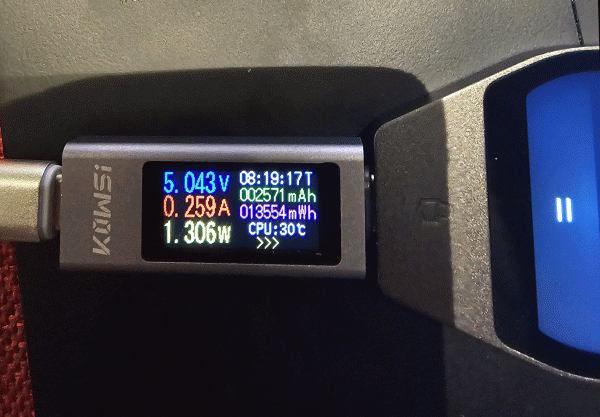
  • Charging current for Trezor Safe 7

    Trezor Safe 7 charging
    click to enlarge

    I have mentioned the Trezor Safe 7 wallet (seen at right) several times in this blog.  Unlike most hardware wallets, it can run on an internal rechargeable battery.  This, of course, means that the user will probably want to charge up the battery.  The manufacturer provides two ways to charge up the battery:

    • place the device on a Qi charging pad (wireless charging), or
    • use a USB C cable.

    I have used both ways, so I know that both ways work for the Trezor Safe 7.

    The natural question that arises is, how fast is the charging?  As may be seen above, the wallet charges at about 1.3W.

    The manufacturer says the battery is a 3.2V, 330mAh LiFePO₄ (Lithium Iron Phosphate) battery.  This means the stored energy might be around 1Wh.  We can thus estimate that if the battery were run way down, it might take 40 or 50 minutes to charge it up.

  • Recovering a bitcoin wallet?

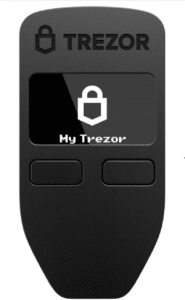
    trezor model 1
    Trezor Model 1

    I tried an experiment yesterday.  The executive summary is that the $20 Trezor Model 1 is a failure as a way to recover a wallet that was created using a Trezor Safe 7.

    Here are the details.  (more…)

Other Posts

Bitcoin user

Skip to content ↓