
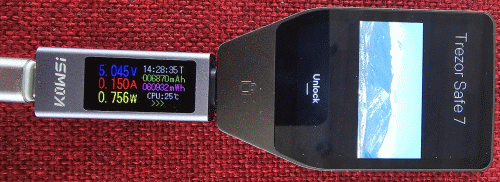
How much power does a hardware wallet consume when it is running?
The Trezor Safe 7 has a bigger and brighter display than most hardware wallets — 2½ inches diagonally, said to have a brightness of up to 700 nits. It also differs from most hardware wallets in having an internal battery. This prompts one to wonder about power consumption and battery life.
Most hardware wallets, of course, are free from such questions. Most of them get power solely from a USB port of a computer or Android phone. A few of them, such as the Tangem card, get power solely from an NFC port of a smart phone.
With the LED brightness of the Trezor Safe 7 set to its dimmest value, the wallet consumes about 283 mW. Set to its brightest, the wallet consumes about 800 mW. This is with the wallet in an idle state. One could imagine more power consumption when Bluetooth is active and when computations are taking place, for example for the cryptographic signing process or for PIN verification. I looked, however, at the changes in power consumption during some of these computational tasks, and it seems the changes are small compared to the overall power consumption from the display alone.
As discussed in this blog article, the capacity of the battery is said to be about one watt-hour. This suggests that with the bright LED setting, service life on a single charge of the battery might be an hour or less. Interestingly, turning down the LED looks like it might triple that service life.
For the would-be purchaser of a Trezor Safe 7, an important thing to keep in mind is that the wallet can be powered by a USB cable. So even if the battery were run down (or fail completely), the device could be used on USB power.
Leave a Reply