
From time to time we see a big price change for bitcoin. What is going on when this happens?
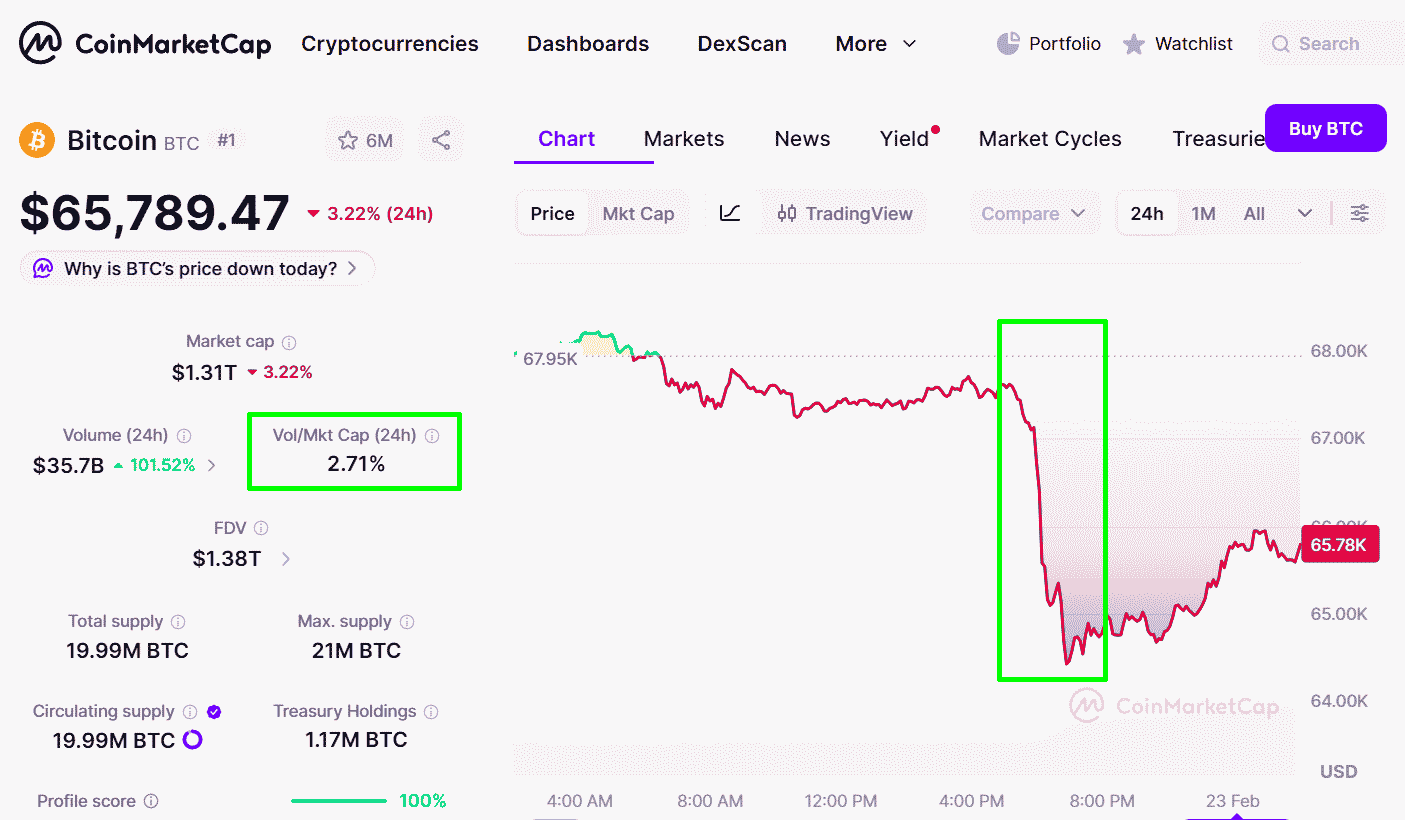
Here (on a very helpful web site called “CoinMarketCap” with a screen shot shown above) we see that at about 7PM on Sunday, February 22, 2026, the price of bitcoin plunged by about 3%. How did this happen? What does it mean? In this blog article I will try to shed a little light on this.
A starting point, for those who hope to learn about this stuff, is to look at a very helpful number called “Vol/Mkt-Cap (24h)”. The number of bitcoin that exist, right now in February of 2026, is about 19.99 million. At present market rates, these bitcoin are worth about $1.3T. By this we mean about 1.3 trillion dollars.
Which is all fine and good, but what we are focusing on right now is the question of how many of those bitcoin changed hands in the past 24 hours? As you can see in this screen shot, in the past 24 hours, about $35B worth of bitcoin changed hands. If you divide one number into another, what you get (as you can see in the screen shot) is that about 2.71% of all the bitcoin that exist changed hands during the past 24 hours.
The number “2.71” might seem like a lot, except that it turns out that for ordinary things that might be bought or sold on an exchange, such as General Motors stock, it is commonplace that the 24-hour trading volume might amount to 5% or even 10% of the outstanding stock. The number 2.71 is a lot smaller than the number 5 or 10.
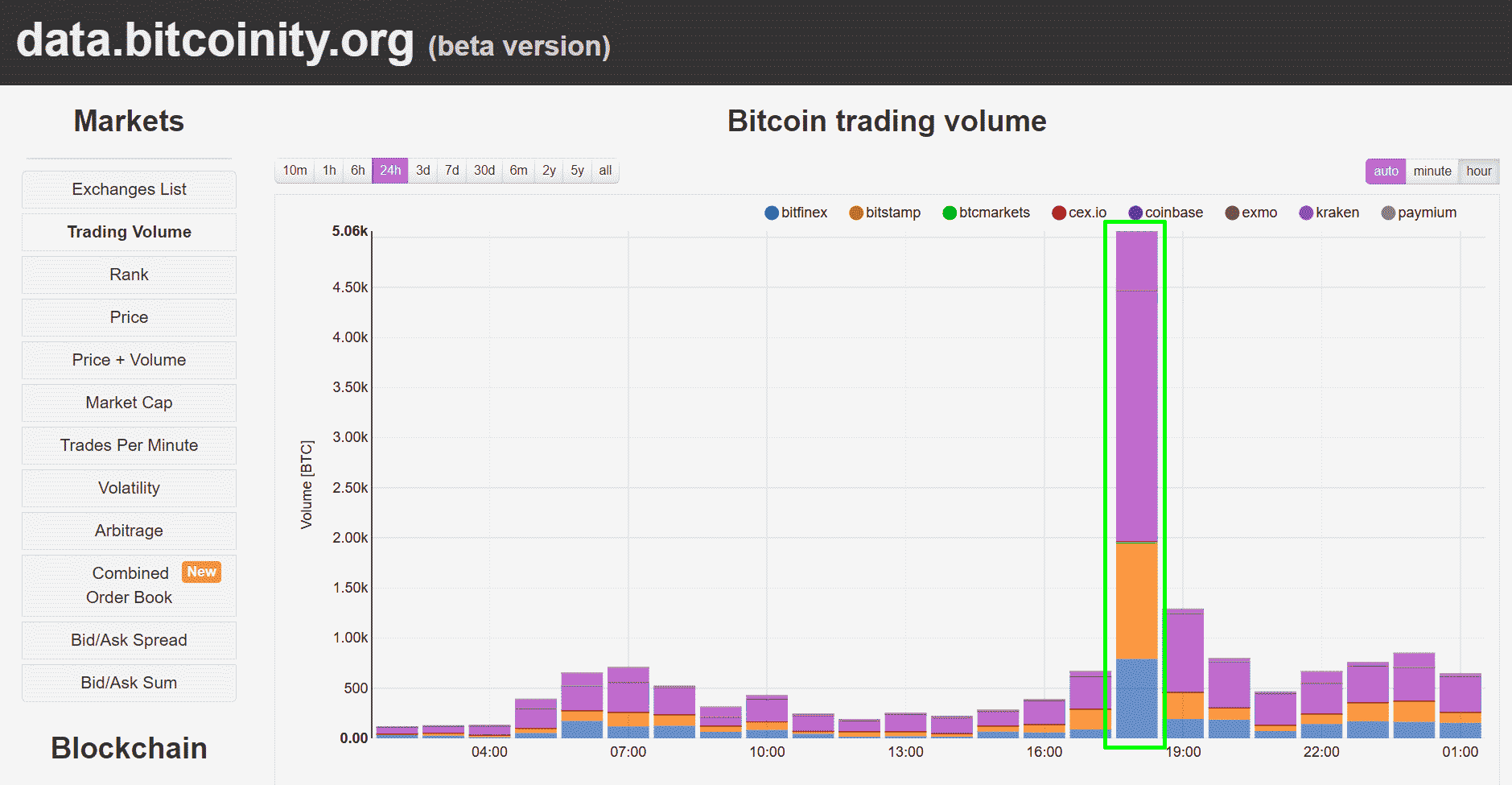
So what we face is that quite often, bitcoin falls into a category of being “thinly traded”. In any given interval of time, it might turn out that some single burst of buying or selling bitcoin, by some individual would-be buyer or seller, can completely overwhelm the market. Some single burst of buying or selling can make the price of bitcoin go up or down a lot. Which brings us to another very helpful web site called “bitcoinity.org“, with a screen shot at right.
What we see is that at around 7PM, somebody sold around five thousand bitcoin. Well, actually, if you look at the colors of the bars, some first party went to an exchange called “Coinbase” (shown in purple) and unloaded about 2500 bitcoin. And at about the same time, some second party went to an exchange called “Bitstamp” (shown in orange) and unloaded about 1150 bitcoin. And at about the same time, some third party went to an exchange called “Bitfinex” (shown in blue) and unloaded about 793 bitcoin.
Overall, this mean that around 5000 bitcoin were more or less “panic-sold”. Several would-be sellers wanted to get cash for their bitcoin, and they had to accept whatever limited number of dollars somebody was willing to pay for those bitcoin.
As you can see from the graph, during other times in this 24-hour period, the trading volume was much lower — a few hundred bitcoin trading in a particular one-hour period.
This high trading volume in a single one-hour period knocked the price of bitcoin down to about $64K per coin. Just minutes earlier, bitcoin were trading at around $67K per coin.
Ordinary stock exchanges tend to operate only during “banking hours”, typically maybe 9:30AM to 4PM Monday through Friday. And for a particular stock, such as General Motors stock, there might be only two or three exchanges available for trading, each operating only during banking hours.
But many cryptocurrencies are able to be bought and sold on quite a few exchanges, and at all hours of the day or night on any day of the week. For bitcoin, as you can see on the screen shot above, there are at least eight active exchanges. Each of them operates 24/7.
The flurry of panic selling that happened at around 7PM on Sunday, February 22, 2026 was not during what most of us would call “banking hours”. It was on a weekend, at a time when some people might have been taking a nap.
After this big price plunge, what happened? What we see is that some corrective action happened, with the price of bitcoin slowly creeping back up, as a sort of correction from the brief period of high trading volume.
There are several learning opportunities here.
Volume-market-cap ratio. One thing is that we should look at the “Vol/Mkt-Cap (24h)” number. When it is big, such as 3% or 5%, that means that there is a lot of trading volume and any particular individual trade is unlikely to make a big difference in the price of bitcoin. But when that ratio is small, such as only 1% or 2%, then we need to recognize that some particular individual trade might make a big difference in the price of bitcoin, at least for a day or two.
Banking hours. A single big trade, or a handful of single big trades, that are outside of banking hours might affect bitcoin price more than one might expect. In contrast, if a trade happens during banking hours, maybe there would be more market participants and the single trade might not affect things so much.
Volatility. There is no choice but to acknowledge that some assets have more price volatility than others. Bitcoin will go up and down more, in short periods of time, than some other less volatile assets such as, for example, General Motors stock.
Today’s blog article talks about what happened when holders of around five thousand bitcoin got the idea, on a Sunday evening, of unloading their bitcoin all at once. If they had had the self-control to wait until mid-day on Monday to unload their bitcoin, maybe they would have been able to get more dollars for their bitcoin. But no, they wanted to do it on a Sunday evening. The handful of sellers who unloaded five thousand bitcoin at around $64K per coin at a thinly traded time might have been able to get as much as $67K per coin during banking hours. Those sellers collectively lost maybe fifteen million dollars.
Sometimes the trading makes the bitcoin price go up. If you were to go to the trouble to capture lots of screen shots from these two web sites, you would find that sometimes a burst of trading makes the price of bitcoin surge rather than plunge. Sometimes what happens is that instead of unloading bitcoin, somebody decides to try to do what it takes to purchase a lot of bitcoin all at once. When this happens, we see the price go way up for a while, typically followed by some corrective action as things return to some price that honors a longer-term trend.
(Update: in this blog article I discuss a burst of trading that made the price of bitcoin surge rathe than plunge.)
What individual people should do? There are some who get excited about the idea of trying to react to short-term price changes. I think this is daft, but that is just me. I favor two things — first, making sure to limit one’s bitcoin holdings to only a small percentage of one’s overall asset allocation. Maybe a percent or two, but not more.
Not only that, but second, I think a person should not hold any bitcoin at all unless one is prepared to take a long view about it.
And I suggest an approach of DCA (Wikipedia article) if one is prepared to take a long-term “buy and hold” approach to a speculative asset like bitcoin. I suggest trying to avoid getting emotionally involved in short-term price swings.
Leave a Reply