
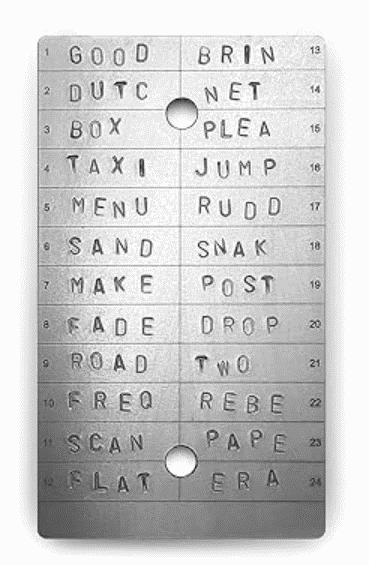
What factors might one wish to take into account when selecting a metal for use in seed plates? What material have many bitcoin owners settled upon? The answer turns out to be titanium, as will now be discussed.
The starting point for many discussions of seed plate materials is the notion of the owner of the bitcoin approaching the remains of a house that might have been destroyed by fire or natural disaster such as flooding, hurricane, or tornado. In this imagining, the house was one of perhaps two locations that the owner selected for storage of a seed plate. Will the seed plate have been melted into unrecognizability? Will the seed plate have been rusted or corroded into unrecognizability?
This naturally prompts one to consider the melting points of various everyday metals and alloys, including the following, ranked by melting temperature:
- 1220°F – aluminum
- 1710°F – brass
- 1983°F – copper
- 2597°F – carbon steel
- 2500°F – stainless steel
- 3038°F – titanium
(The alert reader will point out that the exact melting temperature will be somewhat higher or lower than what is listed, given that there are many distinct alloys that are collectively called “stainless steel” and “brass”, for example.)
Various sources say that a house fire might be 1220°F or 1500°F or 2000°F. This by itself suggests that one should probably eliminate aluminum from consideration for seed plates.
Yet another thing to consider is the corrosion resistance of various metals and alloys. It is easy to imagine a carbon-steel seed plate being rusted or corroded into unrecognizability due to proximity to moisture or acidity or alkalinity, especially in a warm or hot environment.
Those who deal with corrosion in marine (salt-spray) settings are well aware that various alloys of stainless steel differ greatly from one to the next in their resistance to corrosion.
The consensus material choice among some bitcoin owners is titanium.
A next concern is how easy or difficult it is to stamp letters onto a plate depending on its material. One predictor of difficulty is the tensile strength of the material:
- 200 mPa – copper
- 310 mPa – aluminum
- 340 mPa – brass
- 400 mPa – carbon steel
- 510 mPa – 304 stainless steel
- 900 mPA – titanium
(The alert reader will point out that the exact tensile strength will be somewhat higher or lower than what is listed, depending for example on how the metal or alloy has been treated.)
Yes, the easier it is to stamp letters into a material, the more likely it is that the material might melt into unrecognizability in a fire.
The skeptic will point out that if a structure (and the seed plate so carefully tucked away within the structure) were to be washed away by a flood, it might not matter how sturdy or corrosion-resistant the seed plate was.
Leave a Reply